
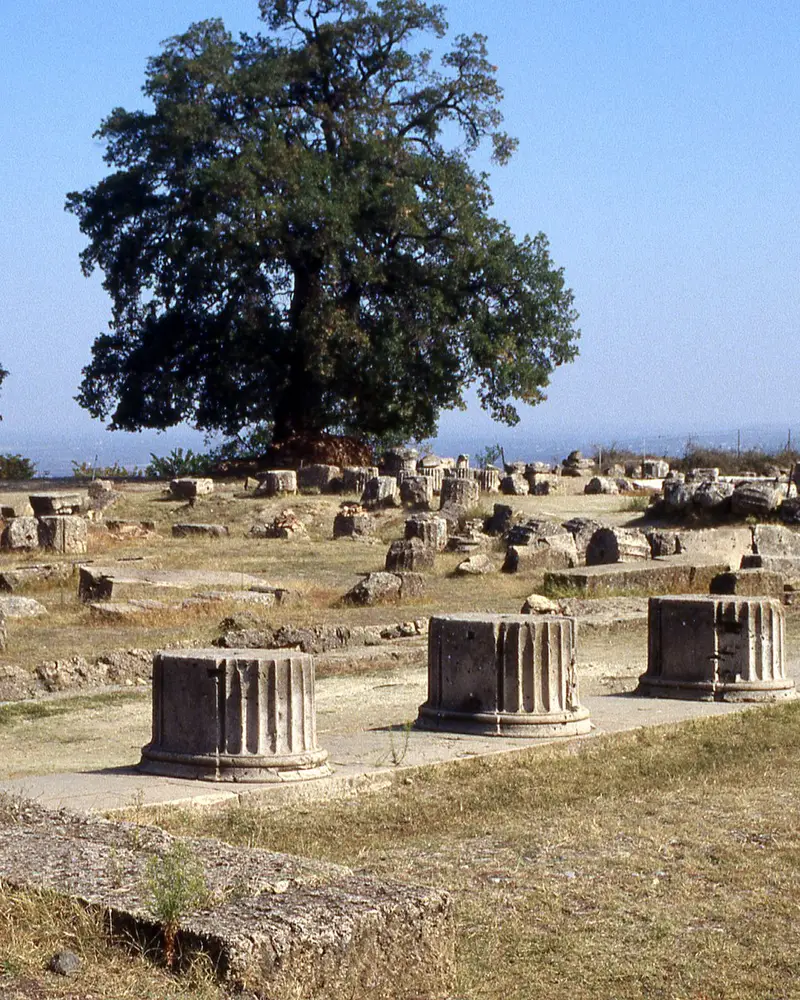
Photo: “Vergina Palace (1990) - 02”, Mark Landon · CC BY 4.0 · Wikimedia Commons. Cropped and resized for the web.
_-_02.jpg)
GREECE · FROM THE 11TH CENTURY BC
Archaeological Site of Aigai (Vergina)
Αἰγαί
It was in the 19th century that Aigai, the first capital of the Macedonian kingdom, was identified near Vergina in northern Greece. Some of the more than 300 tumuli in its burial ground go back to the 11th century BC, and a royal tomb under the Great Tumulus is accepted as that of Philip II, whose conquest of the Greek cities prepared the ground for his son Alexander. The palace, the city’s other great monument, was decorated with mosaics and painted stucco. The period from the 11th century BC spans the whole UNESCO property, which has more than one part; the map marks the ancient city and its necropolis.
- Original name
- Αἰγαί
- Country
- Greece
- Period
- From the 11th century BC
- Civilisation
- Macedonian
- UNESCO
- On the World Heritage List
- Location
- 40.4778° N, 22.3222° E Open in OpenStreetMap Open in Apple Maps
If Antigone is installed, this button opens the city straight in the app.
Areas of the site
-
Palace of Aigai
At Aigai, the first capital of the Macedonian kings, stand the monumental palace with its mosaics and the theatre just below it.
-
Royal Tombs (Great Tumulus)
One of the royal tombs under the Great Tumulus is attributed to Philip II; the mound is now visited as a museum.